
Steiermärkische Krankenanstaltengesellschaft m.b.H. (KAGes)
Steiermärkische Krankenanstaltengesellschaft m.b.H. (KAGes) is the largest healthcare provider in Styria. It has seven regional hospital networks at 24 locations and three state care centers.
Hospital information systems (KIS), such as openMEDOCS, are typically used to comprehensively map all care processes. Care content is managed via catalogs that picture patient care. These catalogs contain a wide variety of variables in tabular form. However, there are currently no suitable interfaces within the KIS for maintaining these catalogs.
KAGes uses the DiZiMa® care classification system to provide patient care. The catalogs included in the system contain care diagnoses and relevant variables according to the diagnosis-goals-measures principle. The DiZiMa® catalog system comprises seven basic catalogs with dependencies on three levels: aetiologies, symptoms, prerequisites, risk factors, care goals, resources and care interventions.
These DiZiMa® catalogs are maintained centrally at KAGes. Experts from state hospitals and state care centers are involved in the revision process. Once approved by central management, any changes are transferred to the KIS. Until now, an MS Access database was used for this purpose, but it was not suitable for maintaining the DiZiMa® catalogs.
The project aimed to develop standardized software to enable KAGes‘ DiZiMa® catalogs to be maintained on a web-based platform by users with no specialist database knowledge.
KAGes‘ goal was to implement a standard system that would enable employees without specialist database knowledge to edit the catalogs decentrally and automatically ensure compliance with the data model, i.e., the dependencies between the individual catalogs.
The following points were particularly important:
With BOI FreeDa, KAGes was able to establish a powerful, standardized solution that is precisely tailored to the complex requirements of the DiZiMa® care classification and the dependent in-house catalogs. BOI FreeDa offers a fully web-based user interface that allows both the central DiZiMa® catalogs and the individual in-house catalogs of the state hospitals and state care centers to be edited intuitively, efficiently, and securely.
With the help of the RI-editor (Referential Integrity) in BOI FreeDa, the complex dependencies between catalogs can be reliably mapped and automatically edited via parent-child links. For instance, the parent-child link between the central DiZiMa® catalog, which assigns individual variables to care diagnoses, and in-house catalogs can be defined. Consequently, deleting an entry in the DiZiMa® catalog automatically deletes it from all affected in-house catalogs. This includes logging and status setting. The RI-editor also facilitates data entry by displaying a list of all valid values from the parent table. With a single click, these values are copied to the child table – this ensures data consistency.
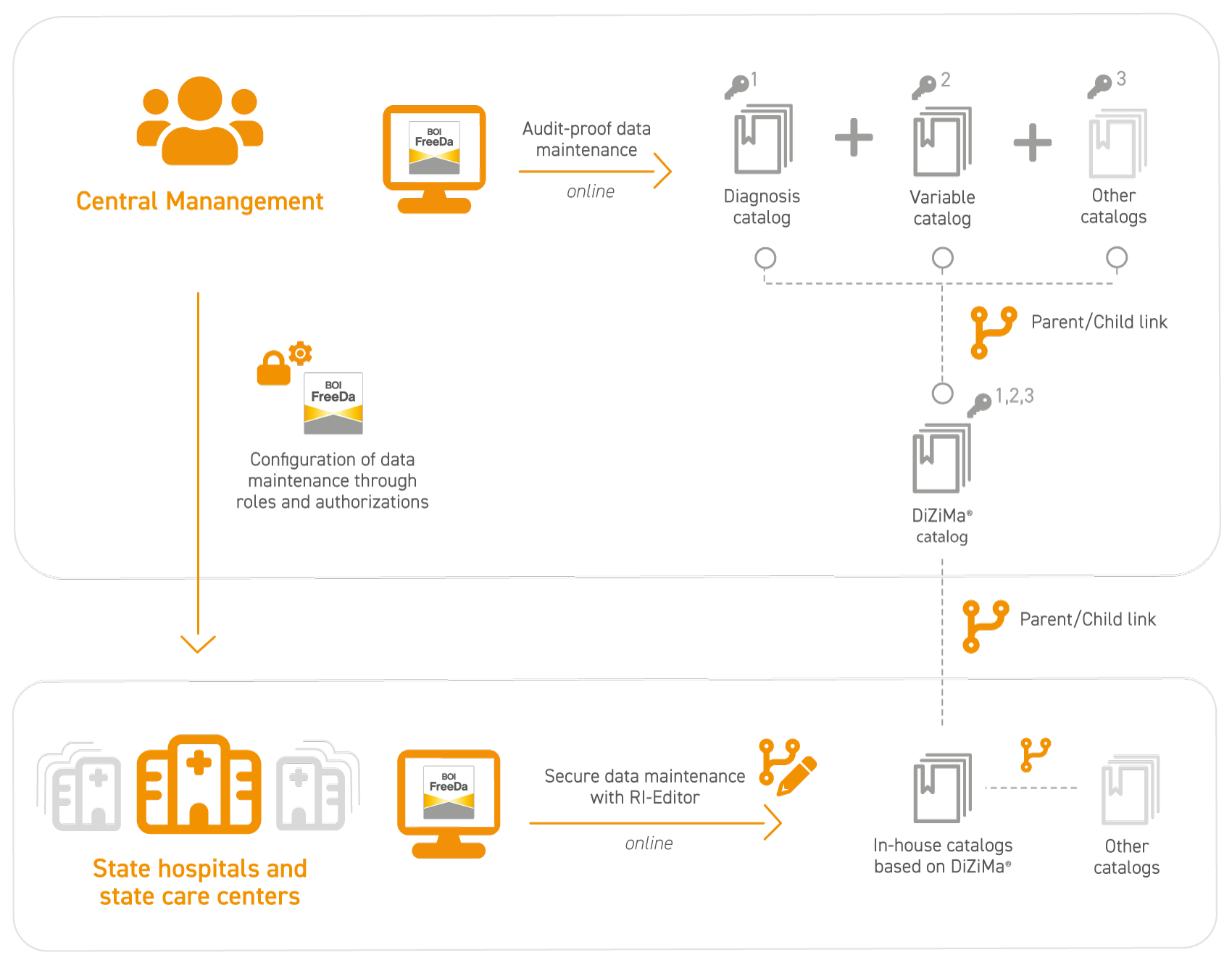
Simplified representation of KAGes catalog maintenance via tenants
Catalog maintenance is now carried out by different employees at various KAGes locations using a modern, highly usable web interface with configurable workflows. Data changes undergo structured processes in accordance with the 2- or 4-eyes control principle. Complete logging of all data changes ensures transparency and traceability, which are key aspects in the healthcare sector and crucial for auditing. The integrated role and authorization system ensures that only authorized users can read and edit the correct catalogs. The database interface for the DiZiMa® catalog has been designed to easily assign variables and interventions to care diagnoses, and vice versa.
Another advantage lies in central control: KAGes‘s central management retains an overview of all changes made by the individual state hospitals and state care centers at all times. According to the 2- or 4-eyes control principle, if a catalog is edited, it can only be checked and released centrally. Extensive checks ensure that only data which is consistent in terms of content and technology is used in the catalogs. Thanks to the logging, preparing data for entry into the KIS is clearer, enabling a harmonious workflow.

Using the standard software BOI FreeDa, KAGes’s requirements for a stable, cross-location solution for the audit-proof maintenancee of DiZiMa® catalogs were met. For the first time, the central catalogs and the dependent in-house catalogs can now be edited directly by different employees in the individual state hospitals and state care centers in a uniform and traceable manner, without requiring special database knowledge.
The ability to automatically map complex dependencies using parent-child links prevents errors and ensures a consistent database. At the same time, BOI FreeDa allows each state hospital or care center to customize the system individually.
Overall, KAGes was able to significantly improve the efficiency of its internal processes and the quality of its data by using BOI FreeDa. This was evident during data migration. BOI FreeDa will also be used to edit other KAGes catalogs in the future, resulting in a quick return on investment.
Conclusion: BOI FreeDa is a stable, audit-proof, user-friendly, and technically flexible solution for editing catalogs in the healthcare sector. BOI FreeDa replaces missing standard functions in KAGes’ KIS and enables the efficient, error-free management of all catalogs in the case of DiZiMa®.