An international life insurance company uses standard software to manage its insurance products, from initial quotations to claims processing. The system is adapted to country- specific and regulatory requirements using extensive master, control, reference and parameter data, which is referred to hereinafter as business-critical data such as interest rates, thresholds, pricing parameters, and validation rules.
This business-critical data, which is stored in over 250 tables within a relational database, forms the backbone of the configuration, both system-wide and on a customer-specific basis. The producer carries out regular software updates as part of minor and major releases. Associated business-critical data is automatically imported and deployed; additional manual changes must be carried out at various points in the deployment process by employees from operating departments.
However, until now, there has been no system capable of mapping the entire process in an audit-compliant, controlled, and fully traceable way, including all transitions in deployment, resets, and process controls.
BOI FreeDa is a standardized, traceable, and secure solution for deploying business-critical
data. It is the leading system for automated and manual data maintenance processes.
BOI FreeDa in practice
BOI FreeDa standardizes the entire maintenance and deployment process, ensuring
security and audit compliance without system discontinuities or data loss.
Advantages at a glance
Within the BOI FreeDa system
Outside the BOI system
Automatic execution
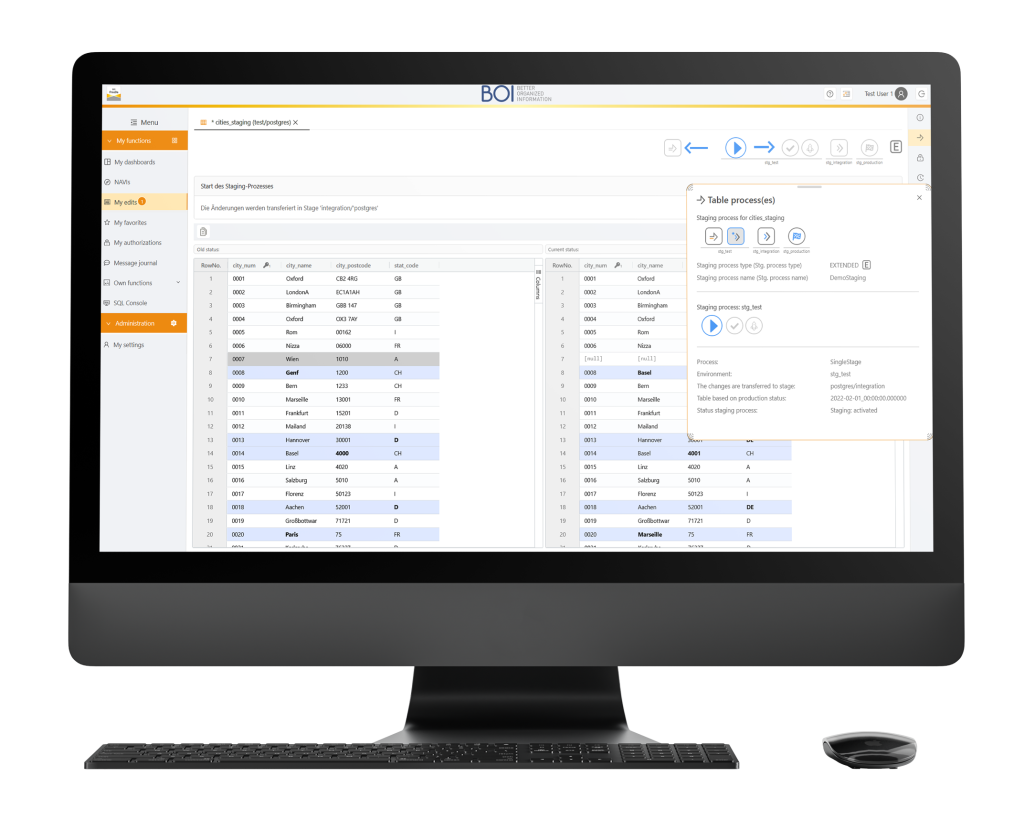
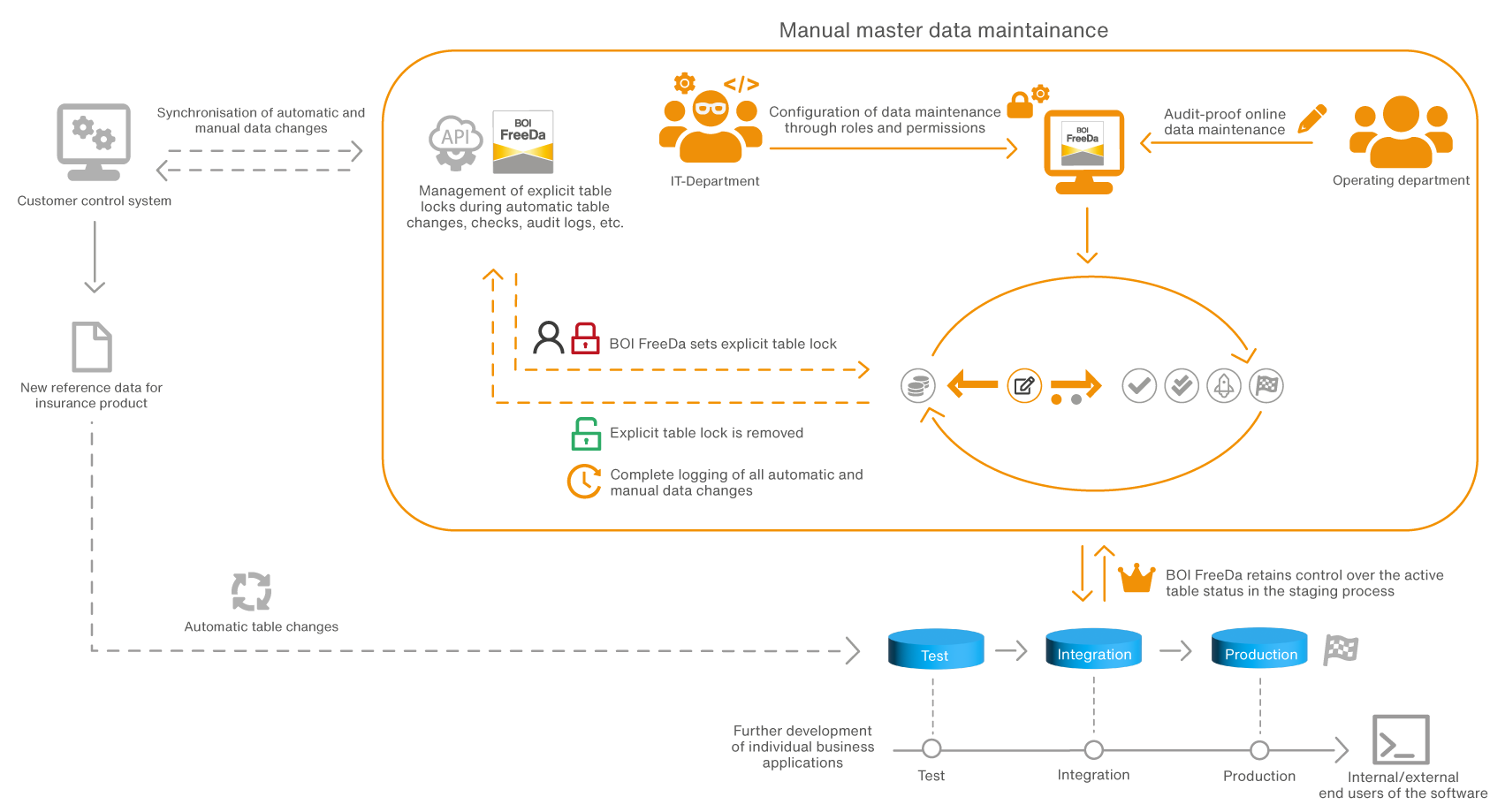
The operating departments manually maintain tables via the BOI FreeDa front end. The IT department configures data maintenance through role- and authorization-based systems, ensuring that only authorized persons can read, edit, verify, or release tables. To ensure data consistency during automatic and manual changes, the customer control system communicates with BOI FreeDa via a REST interface before making automatic changes.
BOI FreeDa verifies that none of the tables to be edited are undergoing manual processing, sets an explicit table lock, and notifies the control system of this action. Next, the customer control system changes the tables directly in the databases and notifies BOI FreeDa after completion.
BOI FreeDa then analyzes the changes, inclusive consistency within the staging process. It also updates the table history to ensure audit compliance and removes the explicit table locks. Once the locks are lifted, the affected tables can be edited manually again.
System environment & data storage
Process: Automated data changes
Process: Manual changes
Feel free to contact us for a free, no-obligation consultation. We look forward to introducing you to our product. The data sent will be processed solely for the purpose of handling your request. For more details, please see our Privacy Policy.